


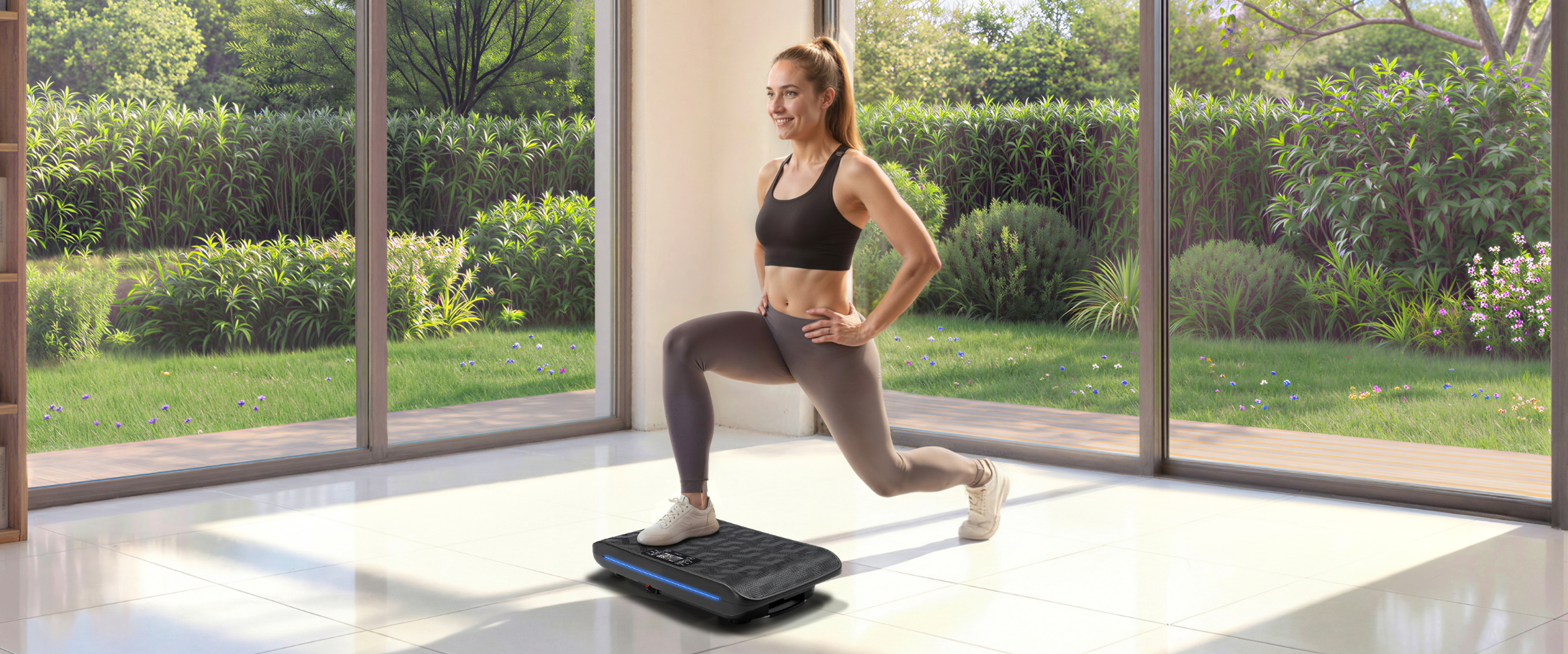
Short on time but still want an effective workout? Imagine stepping onto your device, doing a simple squat, and your body working at full capacity—without complex routines or long training sessions.
That’s exactly the appeal of vibration plate training, yet many underestimate the technology behind it because it looks so simple at first glance. But beneath the surface, something happens that conventional exercises often can’t achieve: an intensive activation of your deep muscles.
The major advantage lies not in replacing conventional forms of exercise, but in efficiency. In a short amount of time, you can apply targeted stimuli that challenge your body without having to schedule long workouts.
In this article, you’ll learn how vibration plate training actually works, what science has to say about it, and how to integrate it effectively into your training.
What’s Behind Vibration Plate Training?
During vibration plate training, you stand on a motorized platform that sends controlled vibrations through your body, directly affecting your muscles. Your body reacts automatically and constantly tries to maintain balance, triggering rapid, reflexive muscle contractions.
The key is that these contractions occur unconsciously and much more frequently than with conventional exercises. Depending on the frequency, there can be up to 30 muscle contractions per second.
This creates a training effect that is most evident in two areas:
- Greater muscle activation in less time
- Strengthening of the deep muscles that are crucial for stability and posture
Modern devices like the sVibe go a step further, using not only simple up-and-down movements but also combining multiple directions of motion simultaneously. These include side-to-side tilting movements, slight rotations, and vertical impulses, known as “4D oscillation.”
For you, this means that your body doesn’t just have to stabilize in one direction but must constantly react to changing stimuli, activating multiple muscle groups at the same time and further challenging your coordination.
Losing Weight with a Vibration Plate: What Really Works
Can you lose weight with a vibration plate? Yes—but the plate can’t do it alone. Weight loss always works on the same principle: you must burn more energy than you consume.
What the vibration plate can do, however, is activate your body efficiently, stimulate your muscles, and increase your energy expenditure—as part of a broader plan that also includes your diet.
The conclusion, therefore, is not “one or the other,” but a clear “both.” Combining exercise and nutrition is the key. The vibration plate is a real game-changer if you’re already active and want to make your training smarter.

Who Is Vibration Plate Training Best For?
Vibration plate training is particularly useful if you’re looking for an effective workout that’s easy to integrate into your daily routine.
Typical uses include:
- Getting started with home workouts
- Complementing strength training
- Training with sensitive joints
- Supporting body fat reduction
Training on a vibration plate is especially effective in a home gym setting. You need very little time and space, yet you can still apply a targeted training stimulus. Vibration is also used for recovery, as it can improve circulation and reduce muscle tension.
As versatile as the training is, there are clear limitations. If you have certain medical conditions, you should avoid vibration plate training or consult a doctor.
These include, among others:
- Pregnancy
- Pacemakers or active implants
- Recent surgeries or bone fractures
- Acute disc problems
- Severe cardiovascular diseases
If you have pre-existing medical conditions or any concerns, it’s always better to check with a professional than to take a risk. After all, a good workout is always one that suits your current physical condition.
Which Muscles Do You Work During Vibration Plate Training?
One major advantage of vibration plate training is its versatility. Depending on the exercise, you can target different muscle groups or perform a full-body workout.
Typical exercises and their effects:
- Squats activate the legs, glutes, and calves
- Planks challenge the entire core
- Push-ups work the chest, shoulders, and arms
- Glute bridges specifically strengthen the glutes and lower back
Activating the deep muscles is particularly important. They stabilize your spine and help improve your posture in everyday life. This makes the training not only effective but also functional.
Which Frequency Is Right for You?
Here’s the bottom line: in vibration training, quality always beats duration. Just a few minutes are enough to trigger reflex-driven muscle contractions—a training stimulus that is otherwise difficult to achieve. This means that recovery is mandatory, not optional.
The right frequency is just as important, because the number of hertz determines what really happens in the muscle—whether you improve flexibility, coordination, or build real strength.
| Training Level | Frequency | Training Goal |
|---|---|---|
| Beginner | 5–12 Hz | Mobilization, balance, and flexibility |
| Intermediate | 12–20 Hz | Muscle function and coordination |
| Advanced | 20–36 Hz | Muscle building and strength |
Three things you should never forget:
- Rest days = growth days. Your muscles get stronger when they rest—not when they’re vibrating.
- Proper form beats every extra minute. Better to be precise than to train longer.
- Add cardio or conventional strength training, because the vibration plate is a booster, not a replacement.
This is how you make the most of vibration training.
When will you see the first results?
As with any training, results take time, but you’ll often notice the first changes after just a few weeks. These include:
- Better muscle tone
- More core stability
- Improved body awareness
Visible changes, such as in body fat or muscle tone, usually appear after about 8 to 12 weeks—provided you train regularly and pay attention to your diet. Consistency is the key factor that will help you reach your goal.
Conclusion
Vibration plate training is not a substitute for exercise, but it is a highly effective complement. It helps you get more out of your training, target muscles effectively, and make your workouts more efficient.
Read more about progressive overload here and discover tips on how to vary your strength training to prevent plateaus and make your home workout not only more effective but also more successful in the long term.



Teilen:
Progressive Overload at Home: 5 Ways to Make Consistent Progress Without a Gym
Cross-Training for Cyclists: The Best Exercises for Improved Performance