


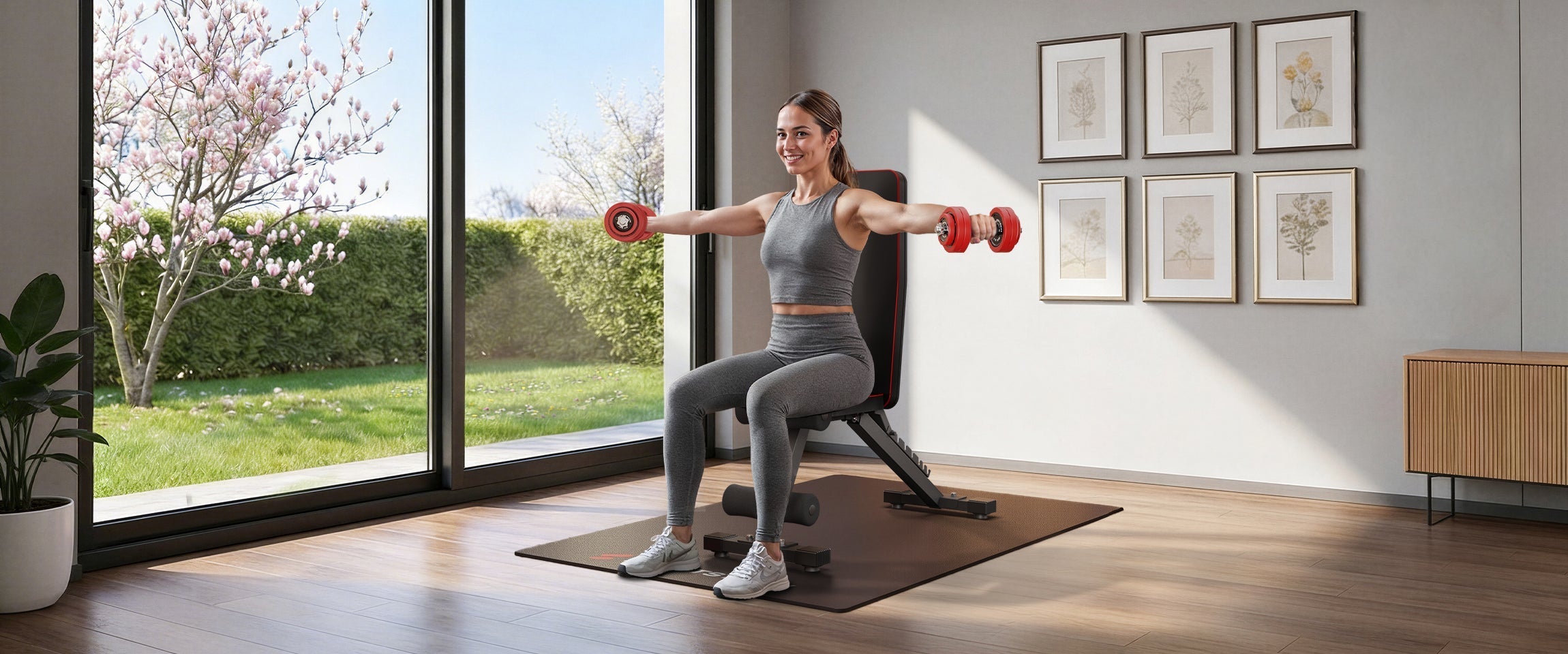
“Heavy weights? That’s nothing for women! “– a phrase you used to hear far too often. Fortunately, this myth has long been debunked. Strength training is not a man’s domain, but an effective tool for more strength, confidence, and long-term health.
Muscles don’t just shape the body; they make it resilient, stabilize posture, and strengthen mental fortitude. Especially for women with little time, strength training is a real game changer: efficient, sustainable, and highly effective.
In this article, we debunk the most common myths, show what the science says, and introduce a smart strength training workout you can try yourself.
Why strength training is so important for women
Your metabolism loves muscles
Muscles are like your inner energy booster: they are metabolically active tissue and increase your calorie expenditure even at rest, such as when sleeping or sitting. Studies by the Rowan University show that resting metabolic rate can increase by around 5% after several months of strength training. That’s a small daily difference, but it has an enormous effect over the course of the year.
In both women and men, the resting metabolic rate (RMR) can decrease from around age 30 due to the natural aging process and the loss of lean mass. Further studies in the American Journal of Physiology show that the accelerated decline from middle age is closely linked to muscle loss, which can be countered with strength training. Complementary endurance training, for example to increase VO₂max, additionally improves cardiovascular fitness and supports metabolic health.
Strength as an anti-aging weapon
Meta-analyses show that without training, 3–8% of muscle mass is lost per decade starting around age 30, with the decline accelerating significantly in later years. Strength training slows this process, improves posture, stability, and functional strength, and helps you stay strong, mobile, and independent even after 50.
Hormone balance & mental strength
Further meta-analyses from J Orthop Surg Res highlight that regular strength training improves insulin sensitivity and supports more stable blood sugar and stress hormone regulation, which is particularly important during perimenopause and menopause. Resistance training can also have a positive effect on self-confidence and stress perception.
Strong bones
Women have an increased risk of osteoporosis—especially after menopause, as declining estrogen levels accelerate bone loss. The Journal of Orthopaedic Surgery and Research shows that targeted strength training can significantly improve bone density in the lumbar spine and hips—making every squat and deadlift an investment in your resilient future self.
Myths about strength training in women
Myths surrounding strength training can prevent women from discovering their own strength. Many of these beliefs stem from outdated beauty ideals, misinterpretations of studies, or simply fitness marketing. It’s time to clear things up and debunk the biggest strength training myths for women once and for all.
Myth 1: Strength training makes you “masculine”
The fear of getting “too buff” can deter some women from strength training, completely unnecessarily! Women have significantly lower testosterone levels than men. Since testosterone plays an important role in muscle building, the absolute muscle gain in women is lower—but progress through strength training is just as effective and measurable. With regular, holistic strength training and the right nutrition, you’ll build a toned body that is healthy, athletic, and entirely focused on your well-being.
Myth 2: Women have to train differently than men
From a sports science perspective, special “lady workouts” are not necessary. The basic principles apply to everyone: progressive overload, proper technique, and sufficient recovery. Differences may arise from individual goals, such as whether the focus is on muscle definition, strength gains, or performance.
Myth 3: Only light weights make sense for women
“Toning” with mini weights will only take you so far. Weights that are too light do not provide enough stimulus for your muscles to grow or become significantly stronger. If you can still chat easily during the last repetition of your set, it’s time to increase the weight.
Myth 4: Strength training doesn’t help you lose weight
Cardio burns many calories during the workout. Strength training, on the other hand, creates a higher calorie expenditure in the long term. More muscle mass permanently increases your resting metabolic rate—meaning you burn more energy even while sleeping. At the same time, strength training protects your muscles during a diet. By applying targeted training stimuli, you signal to your body that your muscles should be preserved despite a calorie deficit. This helps you primarily reduce body fat rather than the hard-earned muscle mass.
Pro tip: Those who sleep well can get even more out of their training. Good sleep at night supports muscle building, recovery, and hormone balance. Read here to find out how good sleep takes your strength training to the next level.
Myth 5: Women don’t need muscles
Muscles are like insurance for a strong life, not just a beauty extra. They stabilize joints, protect you from injuries, improve posture, and make every everyday movement easier, often unconsciously. They also support your metabolism, blood sugar regulation, and hormone balance.
Myth 6: Protein is only for bodybuilders
Protein sources such as turkey, fish, soybeans, or quark are not just for bodybuilders. Proteins are natural building blocks for muscles, but also for skin, hair, nails, and hormones. A review in Nutrients shows that active women, especially during stressful periods such as perimenopause or menopause, benefit from adequate protein intake to support recovery, satiety, and muscle building.

Training volume: How much strength training is effective?
Common question: Do women need to train less?
No—you are stronger than you think. Studies from the Journal of Human Kinetics show that women achieve significant gains in strength and muscle mass through strength training—proportionally very similar to men. Furthermore, many studies indicate that women often have greater fatigue resistance and can maintain exertion for longer. Your body is therefore perfectly suited to continuously getting stronger.
For healthy and efficient muscle building in adults:
- 6–12 repetitions per set as the optimal hypertrophy range
- 2–4 sets per exercise
- 2–3 sessions per week
Busy Women's Home Strength Workout
No time for hours-long gym marathons? Full-body workouts at home are your secret weapon. They work several muscle groups simultaneously, especially the major powerhouses (legs, back, chest, glutes).
All you need is your dumbbell set to perform an effective full-body strength workout for women at home.
Here’s how:
Power Warm-up (10–15 min):
Warm up with dynamic moves—arm circles, high knees, light squats, or jumping jacks. Prepare your body so you can get straight to work!
Main Workout:
Focus on proper technique during every exercise.
- Per exercise: 3 sets with a 90-second rest in between
- Weight: Adjust your weight so that the last 2 repetitions of each set are noticeably challenging but you can maintain proper technique.
Cool-Down (5–10 min):
Relax with stretches for your legs, back, and shoulders—breathe deeply, feel the power, and enjoy your well-deserved glow!
| Exercise | Repetitions | Description |
|---|---|---|
| Goblet Squats | 8-10 | 1) Bend your legs and push your hips back, inhaling deeply. 2) Keep your back straight (slight arch), lean your upper body slightly forward, and look ahead. 3) Straighten your legs, push your hips forward, and exhale as you stand up. |
| Deadlifts | 8-10 | 1) Hold the dumbbells in front of your thighs (keep the weight close to your body) 2) Push your hips back, keeping your back straight. 3) Push your hips forward and stand up. |
| Push-Ups | 10-15 | 1) Place your hands slightly wider than shoulder-width apart. 2) Keep your body in a straight line. 3) Lower your chest in a controlled manner and push up powerfully. Beginner tip: Place your hands on an elevated surface, such as a bench, stepper, or wall. (The higher the elevation, the easier the exercise.) Progression: Gradually reduce the height of the elevation. |
| Bent-Over Rows | 8-12 | 1) Lean your upper body forward. 2) Pull the dumbbells toward your abdomen. 3) Lower them slowly. |
| Standing Shoulder Press | 8-12 | 1) Start with the dumbbells at shoulder height. 2) Press overhead. 3) Lower them in a controlled manner. |
| Plank | Hold for 45 seconds per round, and in the last round, hold until you can no longer maintain the position. | 1) Forearms under your shoulders. 2) Keep your body straight. 3) Tighten and hold your core |
Conclusion: Strength knows no gender—it’s your lifestyle
Strength training for women has long been more than a myth—it’s your ultimate game changer for more energy, focus, and quality of life. With targeted strength training and the right training volume, you’re not just lifting weights, but lifting your entire well-being: a higher metabolism, anti-aging protection, stable hormones, a strong mind, and healthy bones—the complete power package in one home workout.
Regular strength training and an active lifestyle give you energy, stability, and strength—regardless of gender.
So grab your dumbbell set, get started, and feel the transformation. Make strength training your daily energy reset!









Teilen:
Learning Pull-Ups: Your At-Home Guide
More steps for a longer life – with the Woodpad Pro